Get free quotes from land surveying services near you
Takes about a minute. Free, no obligation; providers reply to you directly.
I spent three years watching surveyors drop $40,000 on robotic total stations they barely used, while the guy next door was nailing boundary shots with half the gear and twice the precision. The difference wasn’t the equipment—it was knowing what the equipment actually does.
The land surveying industry has a marketing problem. Vendors pitch gear like it’s the difference between success and failure, when the real story is far messier: some tools matter enormously, some are overkill for most jobs, and expensive hardware in inexperienced hands is just expensive hardware.
Here’s what I found when I stopped believing the brochures.
Key Takeaways
- Total stations and GNSS are non-negotiable—but you don’t need the fanciest versions for solid residential work
- Robotic stations cut crew size in half, not accuracy—efficiency gains matter more than the spec sheet suggests
- Software is where the real difference lives—cheap hardware + right software beats expensive gear + wrong tools
- Rugged tablets aren’t luxury; they’re the baseline—field computers handling -20°C to 60°C are table stakes, not premium add-ons
The Short Version
Robotic total stations ($20K–$50K) and RTK GNSS rovers ($10K–$25K) are the core—non-negotiable for modern surveying. But the expensive part of the equation isn’t the hardware; it’s the field software (SurvCE, FieldGenius, Traverse PC) and your crew’s skill with it. A $3,000 perpetual license for field software will change your work more than a $50,000 robotic station in isolation.
What Actually Matters: The Core Equipment Stack
Total Stations—The Workhorse (Not the Magic Wand)
A total station is a theodolite fused with electronic distance measurement (EDM). If you’ve never used one, it measures angles to sub-millimeter precision and distances with infrared, then spits out coordinates.
Here’s the honest part: a total station doesn’t fix a weak crew. The precision spec—1 arc-second angular accuracy, prism reflections accurate to sub-centimeter—only matters if you set it up right, keep the prism perpendicular, and account for atmospheric conditions. Most surveyors get 90% of their accuracy from discipline, not from paying extra for the 0.5” model.
But this distinction does matter:
Manual vs. Robotic: A manual total station requires two people—one at the instrument, one holding the prism. A robotic model lets one operator track the prism remotely, improving field efficiency by roughly 50% and cutting crew costs. That’s real money.
The trap: Robotic stations cost 2–3× more, and vendors market them as “accuracy improvements.” They’re not. They’re efficiency improvements. If your workflow is already tight (small crews, tight schedules), robotic pays for itself. If you’re running loose crews with downtime, it’s overkill.
Reality Check:You can produce survey-grade boundary shots with a $12,000 manual total station and a disciplined crew. A $45,000 robotic model won’t make a careless operator’s shots better—just faster.
GNSS Rovers—Real-Time Positioning, With Caveats
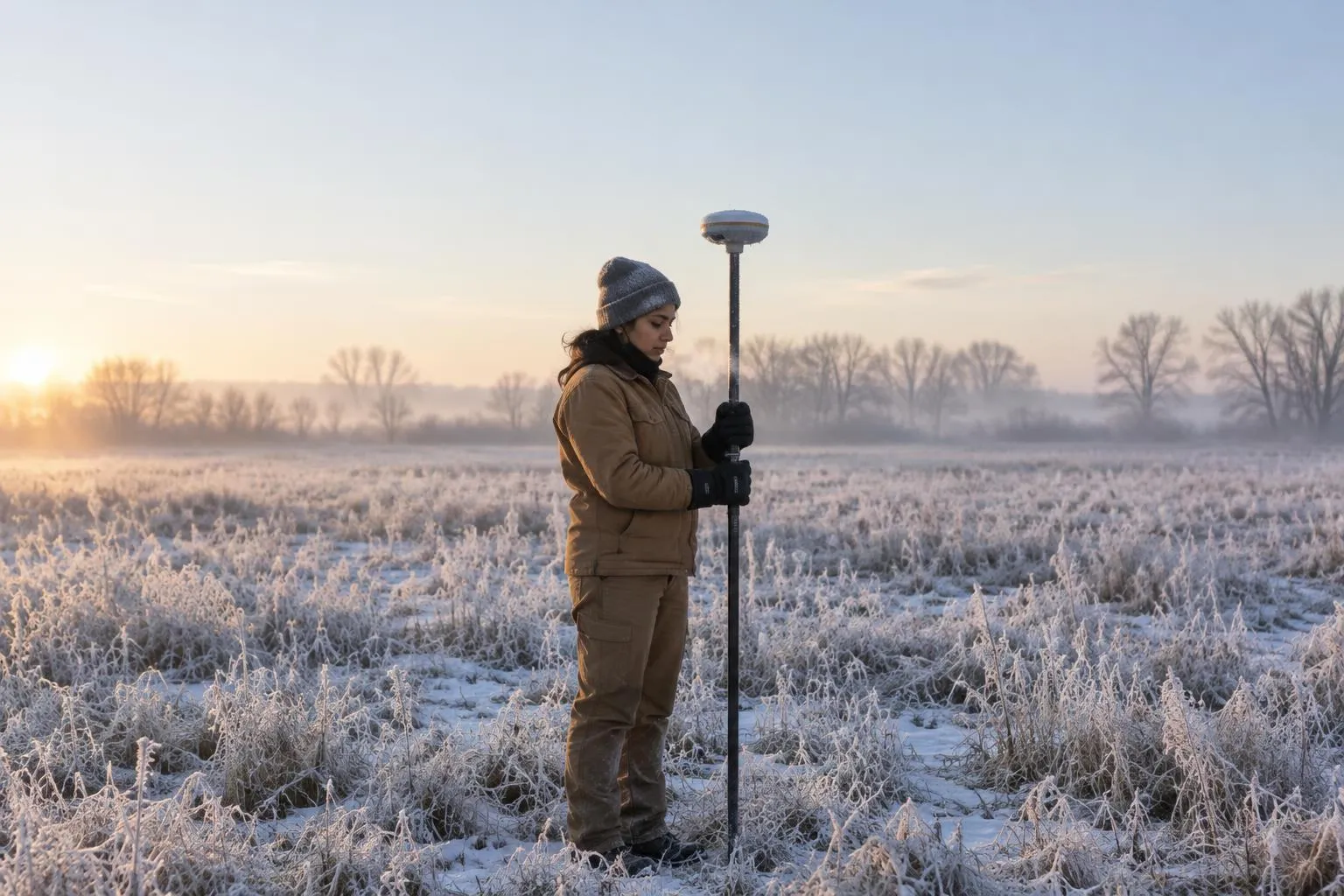
GNSS (via RTK—real-time kinematic) delivers 1–2 cm horizontal accuracy using satellite constellations and differential correction. It’s fast. It eliminates line-of-sight requirements for topographic shots. It’s also not magic.
Where it crushes: Topographic surveys over open ground, stakeout for construction projects, large-scale site mapping. You can collect hundreds of points in a day.
Where it fails: Obstructed areas (urban canyons, under tree canopy), boundary work near building footprints, any shot where you need sub-centimeter precision in tough geometry. Signal loss is real, and your RTK baseline drifts if you lose correction.
The cost reality: A solid GNSS rover runs $10K–$25K. The software to make it talk to your field computer and post-process the data is $2,500–$5,500 per seat (SurvCE, FieldGenius). You’re not buying equipment; you’re buying a system.
Pro Tip:Hybrid workflows—using robotic total stations for boundary/detail shots and GNSS for topo fill-in—give you 80% of the precision at 60% of the cost. Most state boundaries are shot this way now.
The Equipment That Doesn’t Get Enough Credit: Software and Field Computers
This is where I see surveyors throw money away without realizing it.
A rugged tablet running SurvCE or FieldGenius is the actual linchpin. The hardware itself—IP67 dust/water resistance, sunlight-readable screen, MIL-STD-810G drop testing—costs $2,000–$4,000 and lasts four years. The software license is $2,500–$5,500 perpetual, plus $500/year for updates.
But here’s what vendors don’t emphasize: the field computer is where your total station and GNSS become a unified system. Without solid field software, you’re collecting raw shots and post-processing them in the office—which doubles your labor cost.
SurvCE ($2,500–$4,000 per seat) is the industry standard for a reason. It handles robotic total stations, GNSS, levels, and laser rangefinders in a single interface. Real-time DTM (digital terrain modeling) preview. Code-free stakeout for roads and pipelines.
FieldGenius ($3,000–$5,500) is Carlson’s answer, equally robust, with slightly better CAD integration for complex boundary work.
Traverse PC 2026 ($1,200–$3,500) is the budget play—desktop-focused, lighter weight, but you’ll spend more time in the office post-processing.
The difference between using the right field software and the wrong one is about 10 hours of office work per project. Multiply that across a year, and you’re looking at whether your crew can take on one more job per month.
Nobody markets it that way. They market the robotic station. But ask any surveyor who’s used SurvCE—they’ll tell you it’s the tool that changed their workflow.
Comparison: What You’re Actually Paying For
| Equipment | Cost | What It Does | What It Doesn’t Do |
|---|---|---|---|
| Robotic Total Station | $20K–$50K | Measures angles/distances with 1 operator; ~50% faster field crew | Improve accuracy without good technique; eliminate the need for experienced staff |
| RTK GNSS Rover | $10K–$25K | 1–2 cm real-time positioning; unlimited line-of-sight; hundreds of points/day | Work under tree canopy; maintain accuracy in urban canyons; replace total stations for boundary work |
| Field Software (SurvCE/FieldGenius) | $2.5K–$5.5K perpetual + $500/yr | Connect hardware into a unified system; real-time DTM; code-free stakeout; reduce office post-processing by 70% | Make bad shots good; substitute for crew training; work offline without a base station |
| 3D Laser Scanner | $30K–$100K+ | 1+ million points per scan; detailed as-built surveys; complex site modeling | Replace boundary surveying; compete with total station accuracy for single shots; justify itself on residential work |
| Rugged Tablet | $2K–$4K | Run field software in -20°C to 60°C; survive drops; readable in direct sunlight | Last more than 4–5 years in heavy field use; eliminate office work entirely |
Where Marketing Wins and You Lose
The 3D Laser Scanner Fantasy
Vendors pitch laser scanners as the future of surveying. One million points per scan! Millimeter-level precision! It’s true—all of it.
It’s also not a boundary tool. Laser scanners excel at complex site modeling, as-built documentation, and detail capture that would take a manual crew days to shoot. But they’re $30K–$100K+ hardware plays that sit idle 80% of the time for a typical survey practice.
If you’re a 2–3 person firm doing boundary and topographic work, a laser scanner is financing someone else’s R&D department.
Reality Check:A laser scanner is a tool for specialized jobs (large construction sites, facility documentation, complex terrain). It’s not a replacement for total stations or GNSS. If you find yourself justifying it on “future-proofing,” that’s usually a warning sign.
The “1-Millimeter Accuracy” Lie
Theodolites boast sub-millimeter angular precision. GNSS markets “centimeter-level” horizontal accuracy. Laser scanners claim 1–5 mm point precision. All true in lab conditions.
In the field, your actual accuracy depends on atmospheric refraction, temperature variation, operator technique, and how well you’ve tied to known control. Most surveyors get 1–3 cm on boundary work, regardless of what the spec sheet says.
Spending $50K instead of $25K to improve from 2 cm to 1.5 cm is marketing working perfectly.
The Real Efficiency Gain: Robotic Stations + Right Software
Here’s where the math works: A two-person manual crew shooting 150 detail points per day using a standard total station can switch to a one-person robotic setup and hit 200+ points per day while reducing labor costs by 30–40%.
That’s not marketing. That’s accounting.
But it only works if:
- You’re using field software (SurvCE, FieldGenius) that actually integrates with the robotic station
- Your operator is trained on the workflow
- You have enough work volume to justify the upfront cost
A single boundary survey doesn’t justify $50K in robotic hardware. But run 20 surveys a year, and the payback is 2 years. Over a 10-year equipment lifecycle, robotic stations are the better bet for most practices.
Practical Bottom Line
Start here: Total station + field software + rugged tablet. Budget $15K–$20K all-in. You’ll outperform 80% of competitors with this stack.
Add when it makes sense: RTK GNSS if you’re doing topo-heavy work. Robotic total station if crew labor is your biggest cost. Laser scanner if you’re chasing specialized work.
Never buy because: It’s the latest model, the vendor says it’s “industry standard,” your competitor has one, or the spec sheet looks impressive.
The surveyors I know who’ve stayed profitable and sane aren’t the ones with the fanciest gear. They’re the ones who bought what solved a real problem, trained their crews deeply, and didn’t confuse equipment cost with business value.
Next steps: Sit down with your last 20 surveys. Track how much time you spent in the field vs. post-processing. If field software is costing you, that’s your first upgrade target—not the hardware.
For a deeper understanding of how surveying actually works, check out the Complete Guide to Land Surveyors. And if you’re evaluating your whole surveying workflow, the Land Surveying Process: Step-by-Step walks through where equipment decisions actually affect project outcomes.
Done reading? Get quotes from land surveyors near you.
Takes about a minute. Free, no obligation; providers reply to you directly.
Popular cities: