Are you a land surveyor?
SurveySlate lists 558 land surveyors. A free listing gives you a profile page and quote requests from people looking for land surveying services near you, sent straight to your inbox.
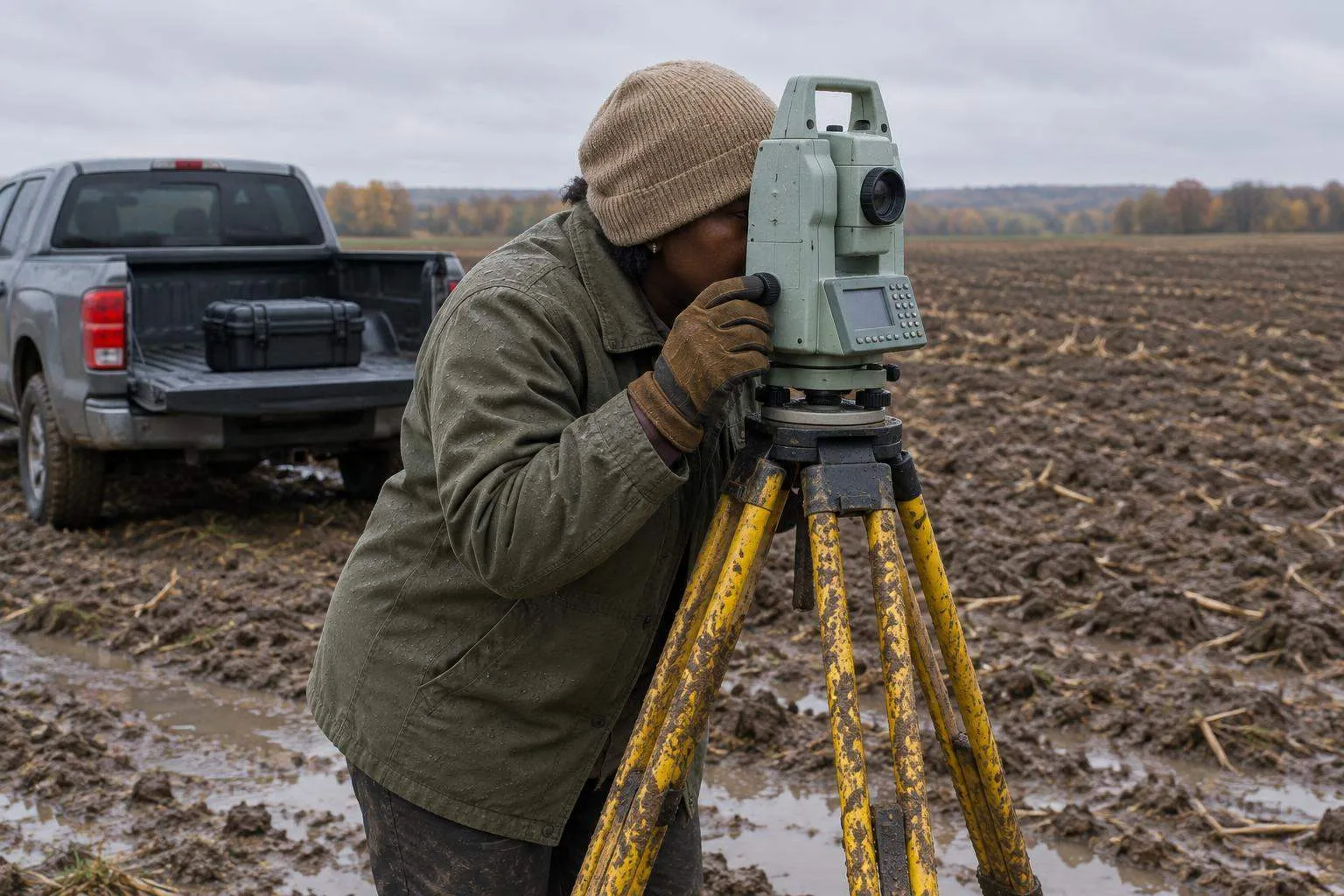
I watched a surveyor stand in a muddy field for six hours, taking measurements with a total station while his crew manually recorded data on clipboards. Meanwhile, a drone equipped with LiDAR sat in his truck, mostly unused. When I asked why, he said, “I don’t trust the AI to get the boundaries right. One mistake and I lose my license.”
That conversation haunted me, because it perfectly captured the tension happening right now in the surveying industry: AI can do some things faster and better. But it absolutely cannot do the thing that actually matters—the thing that protects someone’s property rights and keeps a surveyor’s professional license intact.
So will AI replace land surveyors?
The Short Version:No. AI will automate the tedious parts of surveying (data processing, terrain mapping, report generation), but human judgment remains mandatory for boundary verification, quality control, and legal responsibility. The surveyor who learns to work with AI wins. The one who ignores it gets left behind.
Key Takeaways
- AI reduces processing time from hours to minutes, but every output still needs human verification before it gets signed and sealed
- 60% timeline reductions are real (see: Colorado DOT’s 2022 drone project), but they come from hybrid workflows, not replacement
- The job is changing, not disappearing—surveyors are shifting from data collection grunt work toward analysis, client strategy, and expert-level problem-solving
- Misclassifications happen constantly (AI sees a retaining wall as a sidewalk; mistakes in boundary work are career-ending)
What AI Can Actually Do (And Does Well)
Here’s the honest part: AI is genuinely good at specific, repetitive tasks that have historically eaten up a surveyor’s life.
LiDAR data processing. A single flight over mountainous terrain can generate millions of points. Processing that manually? Hours of tedious work—identifying buildings, vegetation, roads, elevation changes. AI does this instantly through machine learning feature extraction. In Colorado, the Department of Transportation used AI-powered drones to survey hundreds of miles of mountainous terrain in 2022. The result: a 60% reduction in project timeline.
Terrain mapping at scale. AI-enabled UAVs can survey hundreds of acres in a single flight, generating detailed topographic data that gets processed in real-time. This is impossible with traditional crews. For large infrastructure projects, this speed is not incremental—it’s transformative.
Data anomaly detection. Self-calibrating instruments now use machine learning to catch errors in GNSS measurements and total station readings before they become problems. Predictive maintenance algorithms also monitor equipment in real-time, extending lifespan and reducing downtime.
Extracting features from imagery. Mobile LiDAR combined with AI can automatically identify road striping, curbs, and other features for GIS inventories. Again: faster than humans, fewer mistakes on routine classification tasks.
Pro Tip:If you’re a surveying firm still processing LiDAR point clouds manually, you’re leaving 10+ hours per week on the table. Tools like Trimble eCognition exist specifically to automate this. Adopt it or your competitors will.
The villains here aren’t AI companies—they’re inefficient workflows. AI solves that problem.
What Still Requires a Human (And Always Will)
But here’s where the conversation usually gets hijacked by either tech optimists or Luddites. Both miss the point.
Boundary verification. This is the legal core of surveying. A boundary line determines whose land is whose. It’s the basis for property rights, real estate transactions, mortgage documentation, and, when there’s a dispute, expert testimony in court.
AI cannot do this work. An algorithm can process LiDAR data and flag inconsistencies, but a surveyor must manually verify control points, research deed history, check for conflicting measurements, and ultimately sign their professional seal on the result. That seal means: “I’ve checked this. I’m liable for it. I’ll defend it in court if necessary.”
Every state licenses surveyors separately. Every deliverable gets signed and sealed by a licensed professional. That’s not bureaucracy—it’s accountability.
Quality control on critical data. Real-world example: AI classifies a retaining wall as a sidewalk because the training data wasn’t perfect. In a boundary survey, that’s a career-ending mistake. The RICS Journal and Land Surveyors United both emphasize the same point: AI detects errors and inconsistencies, but human surveyors resolve them.
Complex analysis and client strategy. As AI handles routine data processing, surveyor time shifts toward higher-value work: interpreting results, advising on compliance, identifying potential boundary issues before they become problems, explaining findings to clients and attorneys.
Reality Check:If an AI system generates a survey report without human verification, and that report is wrong, nobody’s license is on the line. The surveyor’s is. This is why verification isn’t optional—it’s structural. The professional liability flows through the human.
How the Hybrid Workflow Actually Works
The CDOT example is instructive because it shows what actually happens when AI enters surveying, not what tech blogs promise.
Step 1: AI drones collect data. LiDAR, photogrammetry, raw imagery. Speed: fast. Cost per acre: low.
Step 2: AI processes the data. Feature extraction, point cloud classification, initial terrain modeling. Speed: minutes instead of hours.
Step 3: Surveyors verify and refine. Check control points. Cross-reference against existing records. Resolve ambiguities. Flag errors for re-collection if needed. This is where the 60% timeline reduction comes from—not from skipping human work, but from eliminating the tedious parts so humans can focus on the parts that actually matter.
Step 4: Professional sign-off. The licensed surveyor approves the final deliverable.
This is not replacement. It’s augmentation.
| Task | Traditional Approach | AI-Assisted Approach | Impact |
|---|---|---|---|
| Point cloud processing | Manual classification (8+ hours) | AI automation + human QC (1-2 hours) | 75% faster |
| Anomaly detection | Surveyors eyeball data | ML algorithms flag inconsistencies | Fewer missed errors |
| Feature identification | Human-only extraction | AI extraction + human verification | Speed + accuracy |
| Boundary verification | Manual research + site review | AI-compiled records + human analysis | Better informed decisions |
| Report generation | Manual transcription + editing | AI drafting + human refinement | Hours saved per project |
The pattern is consistent: AI handles volume and speed. Humans handle judgment and accountability.
The Real Threat (And It’s Not What You Think)
If AI replaces surveyors, it won’t be because of better technology. It’ll be because of business model erosion.
Right now, surveying fees range from ~$500 for a simple residential boundary survey to $5,000+ for complex commercial or ALTA work. If AI reduces operational costs significantly (fewer field personnel, faster project turnarounds, predictive maintenance extending equipment life), some firms will drop prices to capture market share. Others will go out of business.
The surveyor who learns to integrate AI into their workflow—and charges appropriate fees for the analysis and verification, not the data collection—survives and thrives. The one who competes on commodity price for commodity services gets squeezed.
Pro Tip:Your value proposition is shifting. You’re not being paid to collect data. AI can do that cheaper. You’re being paid for judgment, liability, and expert analysis. Price accordingly.
What the Data Actually Says
No credible sources predict surveyor job elimination. The consensus, backed by RICS, Land Surveyors United, and industry practitioners, is consistent: AI changes the job, not the existence of the job.
What does change is the skill set. Surveyors who understand data processing, can work with GIS systems, and can interpret AI outputs will be in demand. Surveyors who refuse to engage with the tools will find themselves competing on price against firms that have cut their operational costs in half.
Practical Bottom Line
If you’re a surveying professional, here’s what to do now:
-
Learn one AI-augmented workflow tool (Trimble eCognition, Pix4D, or equivalent). You don’t need to become a data scientist. You need to know what it does and how to interpret its output.
-
Audit your current processes. Where are you spending 5+ hours on routine, repetitive work? That’s where AI saves you. Redirect that time toward client consultation and analysis.
-
Establish quality control protocols for AI outputs. What gets verified? By whom? How? Document it. Liability flows through these decisions.
-
Rethink your pricing. If AI cuts your processing time in half, your profit per project might increase—or you might lower prices slightly to win more work. Either way, don’t leave money on the table by competing on the work AI is doing.
-
Stay licensed and current. Your professional credential is your moat. Keep it sharp. AI can process data faster, but you’re the one signing the seal.
For deeper context on how the surveying profession is evolving more broadly, check out The Complete Guide to Land Surveyors to understand the full scope of what surveyors do and how they’re positioned in the market.
The surveyor I watched in that muddy field six years ago? He’s still there, still doing things the old way. His fees are competitive, but his margins are tighter every year. The firms that invested in AI workflows? They’re doing more projects, charging better rates, and spending less time on data drudgery.
AI didn’t replace him. Smarter competitors did.
Done reading? Get quotes from land surveyors near you.
Takes about a minute. Free, no obligation; providers reply to you directly.
Popular cities: